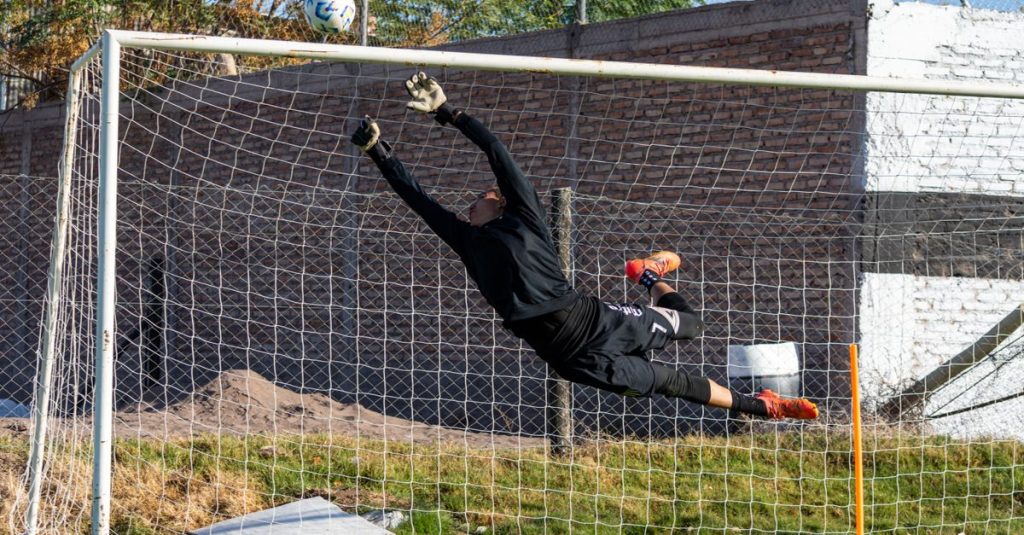
David Raya received more FIFPRO World XI votes than any other player, goalkeeper or otherwise, with a total of 10,278 from the 20,000 professional players who voted. Unai Simon won the goalkeeper of the year award at the Ballon d’Or ceremony, but Raya’s support from his peers was the strongest of any player.
Raya had to settle for a supporting role during Spain’s World Cup campaign, as Simon started every game and remains Luis de la Fuente’s first choice in the position. Raya’s FIFPRO vote share, however, reflected how his fellow players view him.
Arsenal share that view. Their new contract for Raya will reflect his standing as one of the world’s best, recognise his vital role in last season’s Premier League title win, and reward how he has flourished since joining from Brentford in 2023.
The qualities that make Raya special
Raya is now a three-time Golden Glove winner who has kept clean sheets in nearly half of his 117 Premier League appearances for Arsenal. He has an even better record in the Champions League, with 21 shutouts in 40 games over the same period.
The numbers are extraordinary, but clean sheets are a collective achievement. A deeper look at the data is needed to build a true picture of Raya’s individual excellence.
Gradient Sports grades players out of 100 based on the quality of their execution rather than the volume of their actions. Its data has Raya as the Premier League’s best or second-best performing goalkeeper for a third straight season, which reflects his consistency.
That grading system factors in a broad range of performance elements, including shot-stopping, and Raya continues to shine in that area.
According to Gradient, which also grades shot quality, Raya is the only goalkeeper in the Premier League this season yet to concede a saveable goal. By comparison, the data shows that Emiliano Martinez, Alisson Becker and Gianluigi Donnarumma have conceded three, four and five respectively.
This is not a statistical quirk. Since the start of last season, Raya has conceded just six saveable goals, which equates to 0.13 per 90 minutes. That is the lowest rate of any goalkeeper who has played at least 20 per cent of available Premier League minutes.
Raya’s reflexes are central to his shot-stopping, and the quality of his positioning is another key factor. Gradient’s analysts found that he has not made a single positional error when facing a shot this season.
Raya is also well protected. Arsenal have the best defence in the Premier League and perhaps in Europe. However, those defenders benefit from Raya’s presence as much as he benefits from theirs.
In a 2024 interview, Raya highlighted another of his strongest attributes: his ability to claim crosses. He credited this to Iñaki Caña, the goalkeeping coach who followed him from Brentford to Arsenal.
“If you watch highlights from me when I was back at Blackburn, you will see a ‘keeper that just stood on the line, not coming for anything, rarely going for a cross, rarely going outside the box, rarely anticipating, just waiting to make that save,” he said.
“When I signed for Brentford, Iñaki just completely changed my style of being a goalkeeper, to be more proactive and anticipate stuff that has not happened yet. So, if you can go for a cross, just go for it. Don’t wait for the save. Instead, avoid the chance.”
Brentford fans will recall him being caught off his line by Joe Byram’s long-range free-kick in the 2020 Championship play-off final. Arsenal fans will remember him failing to reach a high ball before Brian Brobbey’s 94th-minute equaliser away to Sunderland.
The rewards, however, comfortably outweigh the risks.
This season, Gradient’s data on crosses caught, which counts crosses claimed at waist height or above, shows Raya top among Premier League goalkeepers with 13. He achieved that despite facing roughly 20 per cent fewer crosses than the two goalkeepers closest to his total.
Raya’s dominance from crosses acts as a pressure release valve for Arsenal when they defend their box. His work this season helps explain why the Gunners have one of the lowest opponent cross completion rates among Premier League sides.
Raya stands 6ft 1in, which is shorter than the average goalkeeper. Instead, he relies on his spring and athleticism when commanding his box. In possession, he benefits from a vision that once prompted Jurgen Klopp to say he “should have number 10 on his back”.
According to Gradient, Raya has completed the joint-most line-breaking passes of any Premier League goalkeeper this season. His total of 33 level with Aston Villa’s Zion Suzuki, but Raya’s success rate is higher at 87 per cent compared with Suzuki’s 79 per cent.
Suzuki stands out in the data as another goalkeeper who offers proactivity on crosses as well as progressive passing ability. However, the Villa goalkeeper has already conceded five saveable goals this season, which is nearly as many as Raya has conceded in the last two seasons combined.
It is that completeness in shot-stopping, cross-claiming and distribution that sets Raya apart from the rest of the Premier League. The Ballon d’Or voting went another way, but his case to be considered one of the world’s best is strong.
Jaissle’s pressing problem
Arsenal’s next test comes at St James’ Park, where Newcastle boss Matthias Jaissle could really use a result. The match is live in the UK on Saturday. Jaissle has won only one of his five Premier League home games since arriving from Saudi Arabian club Al Ahli.
Speaking to him during his time at Red Bull Salzburg, where he won back-to-back Austrian titles between 2021 and 2023, offered insight into his philosophy. Jaissle favours quick, vertical attacks, but the point that came across most strongly was the importance he places on out-of-possession work.
“The mentality is important, to see the nature of the player,” Jaissle said. “Does he really want to chase the ball, to win it back? We also have a saying that mentality eats talent.”
Jaissle wants his teams to channel their intensity into Jurgen Klopp-style counter-pressing, which means attempting to win the ball back within a few seconds of losing it. The idea is to exploit an opponent’s disorganisation in the moments after regaining the ball, ideally high up the pitch.
Jaissle’s Red Bull Salzburg excelled on this front. In their 2021/22 and 2022/23 Champions League campaigns, they ranked ninth and seventh respectively among the 32 competing sides for possessions won in the final third per game. His Newcastle players, however, have so far struggled to make the same tactics work.
According to Opta, Newcastle sit 17th among Premier League sides for high-intensity counter-pressures this season.
Brighton, Arsenal and Manchester City, the Premier League’s top three, also rank low on that list. That is largely because they dominate possession, averaging roughly 60 per cent, which leaves fewer chances to counter-press. Newcastle, by contrast, average only 50 per cent possession.
Where the counter-pressures take place reveals more about Newcastle’s struggles. While Brighton, City and Arsenal rank among the sides with the highest percentages of counter-pressures in the final third, Newcastle sit among the lowest.
Newcastle’s share is just 36 per cent in the final third, compared with 56 per cent in the middle third and eight per cent in the defensive third. That means they counter-press in less dangerous areas and less often than most of their rivals.
For Jaissle, these issues are compounded by structural problems that give opponents space to attack when Newcastle’s pressing fails. This is shown by their Premier League-high total of 20 shots faced from fast breaks this term.
Expect Arsenal to be set up to capitalise.
Player Radar: Who else to keep an eye on
After a difficult season in front of goal last term, Evanilson is becoming another Bournemouth success story. He faces Nottingham Forest on Saturday having scored, assisted, or done both, in seven of his last eight games in all competitions.
Live Radar: What’s on TV this weekend?
Four Premier League games are broadcast live in the UK this weekend, starting with Newcastle hosting Arsenal at 5.30pm on Saturday.
On Sunday, Hull City take on Brighton at 2pm, before Liverpool face Manchester United in Mauricio Pochettino’s first game at 4.30pm.
Finally, Brentford face Everton on Monday Night Football at 8pm, with coverage starting at 6.30pm.
Last week’s Radar
Last week’s column made the case for Estevao to play more minutes for Chelsea and highlighted Brighton’s incredible physical intensity, summed up by Pascal Gross, in their win over Liverpool.